How to stick with voice journaling when typing has failed you
I have started a journal about six times. Paper ones, an app with a streak counter, a fancy notebook I felt too guilty to write badly in. Every one of them died inside a fortnight. The pattern was always the same: the day got long, the idea of sitting down to type felt like one more task, and so I just didn't. If you have tried voice journaling, or you are about to, this is the honest version of what makes it stick and what quietly kills it.
The short answer is that talking is faster than the part of your brain that talks you out of journaling. That gap is the whole game.
Why typing journals fail and talking doesn't
The friction with a typed journal isn't the writing. It's everything before the writing. Open the app, wait for it to load, find today's entry, sit up straight, decide on a first sentence that isn't embarrassing. By the time I had done all that, the thought I wanted to catch had usually wandered off.
Speaking skips most of that. You press one button and start talking, the way you would if a friend asked how your day went. There is no blank page to perform for. I have recorded entries half asleep, walking to the shops, sitting on a train somewhere between two co-living places in Taiwan. None of those are moments I would have opened a laptop.
The catch nobody mentions: talking out loud feels strange for about a week. You will hear your own voice say something a bit too honest and want to delete it. Don't. That awkward first week is the price, and it does pass.
Start with a walk, not a desk
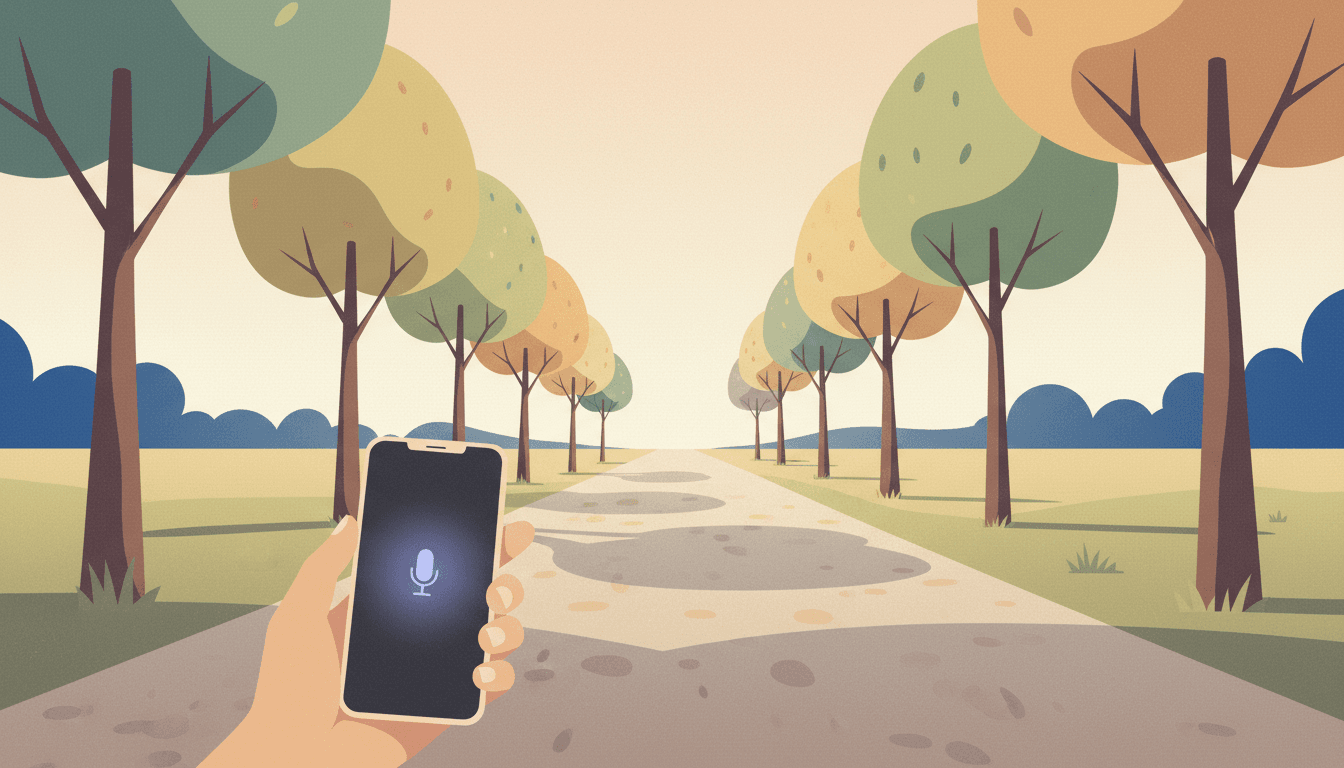
The single thing that made voice journaling stick for me was tying it to a walk. Not a scheduled "journaling session". Just the walk I was already doing most mornings.
A walk solves three problems at once. You are alone, so you talk freely. Your hands are busy, so you are not tempted to edit. And your body is moving, which for some reason loosens the honest stuff. I get more out of ten minutes talking on a walk than I ever did from twenty minutes staring at a cursor.
If you don't walk, find the equivalent: the drive home, the wait for the kettle, the dog, the ten minutes before anyone else is awake. The rule is that you attach journaling to a thing you already do, so you are not relying on willpower to invent a new slot in your day.
Keep the bar embarrassingly low
Most habit advice tells you to be consistent and then leaves you to figure out how. Here is the version that actually worked.
- One sentence counts. If all you say is "today was a write-off and I'm tired", that is a complete entry. Log it and move on.
- Don't aim for daily at first. Aim for "more often than not". Missing a Tuesday is not a failed habit, it's a Tuesday.
- Never re-record. The first take is the entry. Polishing it is just typing-journal friction wearing a different coat.
- Don't read old entries for the first month. Reviewing too early makes you self-conscious, and self-conscious is what we are trying to get rid of.
I know how soft that sounds. But the people who keep journals are not the disciplined ones, they are the ones who made it so easy to start that quitting took more effort than continuing.
What to actually talk about
The blank-page problem comes back in audio form if you press record with no idea what to say. A few prompts I lean on, in roughly the order I use them:
- What is actually on my mind right now, before I tidy it up.
- One thing that happened today and how I feel about it, honestly.
- Something I am putting off, and the real reason, not the polite one.
- A decision I am sitting on, talked through out loud as if explaining it to someone.
That last one is the one I would not give up. Saying a decision out loud, hearing my own reasoning, catches the wishful thinking I can't see when it's just a thought. I have talked myself out of bad ideas mid-sentence more than once.
Own the recordings, or don't bother
This is the part I care about more than the habit itself. A journal is the most private thing you will ever make, and most journaling apps treat that as a feature to monetise. Your words go to their server, get tied to your account, and you have no real idea what happens next.
I built Luna Journal because I wanted the opposite, and because I wanted it for myself first. Entries stay on the device. There is no account, no tracking, no ads. When you want your words out, you export them to Notion or CSV and they are just yours, in a format you can read in ten years without asking anyone's permission. That last bit matters more than it sounds. A journal you can't get your data out of is one you are only renting.
If you use a different app, fine, but check two things before you pour a year of your life into it: where the recordings live, and whether you can export everything in one go. If the answer to either is murky, assume the worse version is true.
The habit was never the streak. It was having a low-friction way to think out loud whenever you actually need it.
When it stops working, and it will
There will be a week where you don't record anything. I got sick in Tokyo last year and spent four days not leaving the flat, and the journal was the first thing to go. That is normal. The mistake is treating the gap as proof you are not a journaling person, then quitting for good out of something like shame.
The fix is boring. You just start again, mid-stream, with no apology entry about how you fell off. Press record, say what is going on now, carry on. The habit was never the streak. It was having a low-friction way to think out loud whenever you actually need it, which is usually right after a stretch where you didn't.
That is really all voice journaling is. A faster route from a thought to it being out of your head, that you happen to keep. Start on your next walk, keep the bar low, and make sure the words stay yours.
Thanks for reading. If you try it, give it the full awkward week before you decide. That is usually where it turns. Benjamin

More from the devlog.
How to keep a travel journal when you're always moving
Three half-filled notebooks taught me that travel breaks every journaling habit. Here's how to keep a travel journal that survives an actual trip, on the move and on your own phone.
Is your AI journal private? What actually happens to your words
Most journaling apps stay quiet about where your entries go. Here is the honest version: what the cloud model does with your words, what on-device changes, and what to check.